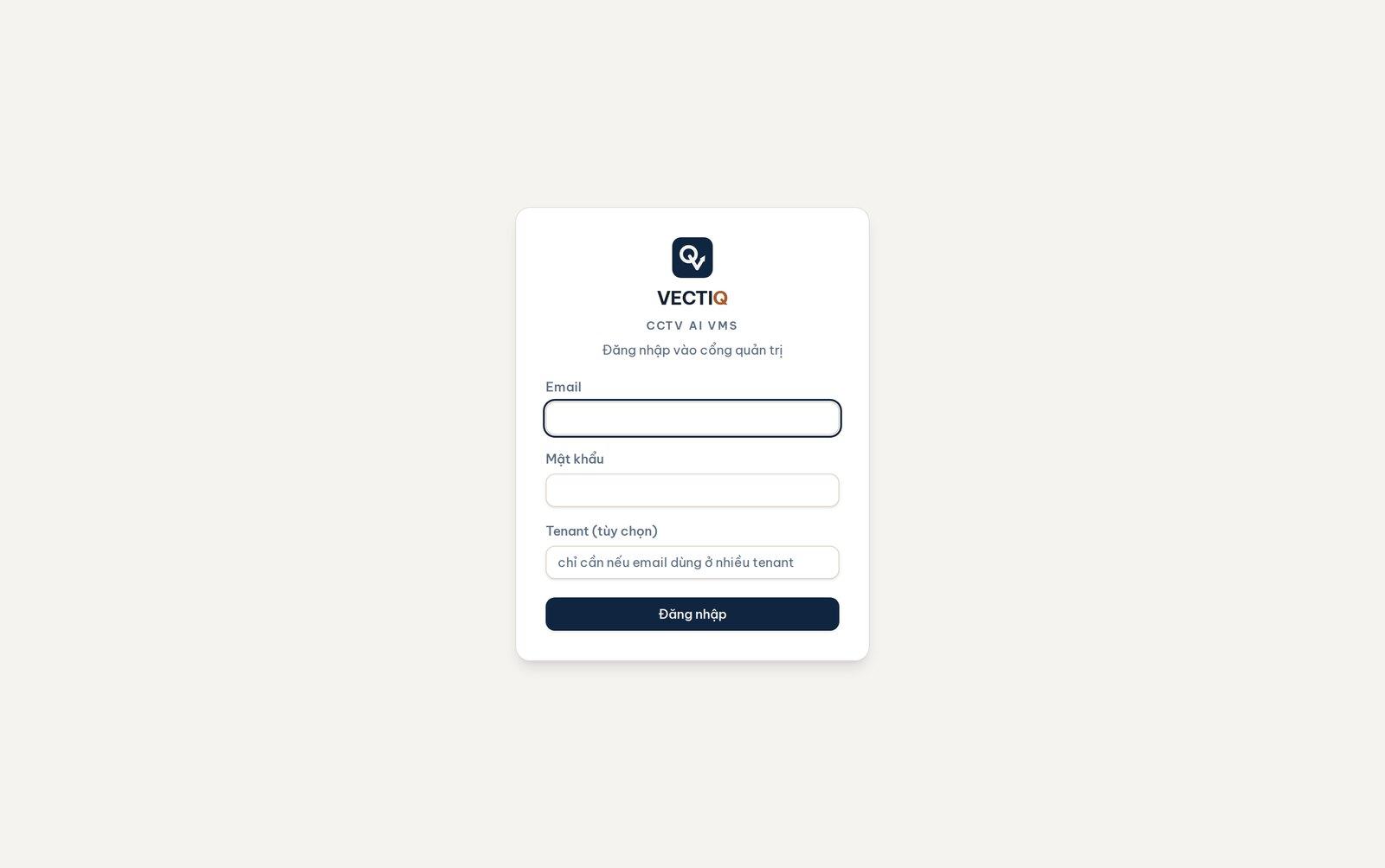
Most camera dealers in Vietnam sell hardware and hand over an NVR interface that was designed in another country a decade ago. The customer gets a grid of cameras, a search that takes a minute, and no way to ask a question like "tell me when a truck comes through gate two after eight in the evening."
Vectiq VMS is our answer to that, and it is deliberately built for the dealer, not only for the end customer.
What "multi-tenant" means here
One installation serves many customers at once. Each is a tenant with its own sites, cameras, users and retention policy, and the isolation is enforced by PostgreSQL row-level security rather than by application code that can forget a filter. A dealer installs the platform once and onboards the fortieth customer the same way they onboarded the first.
Roles go down to the site: a branch supervisor sees their branch, a regional manager sees the region, the tenant owner sees everything, and the dealer's own operators see the fleet of worker nodes without seeing anyone's footage.
What is in the box
- Live view and camera wall. Sub-second live view in the browser, a wall with selectable grids, click to expand one tile, escape to go back.
- Playback you can trust. The timeline shows which spans were actually recorded. Click a gap and it tells you it is a gap, instead of spinning.
- Detection per zone. Draw a polygon on a real snapshot from the camera, not on a blank rectangle, and attach rules to it.
- Faces and plates. Face recognition with anti-spoofing for entry control, and Vietnamese licence-plate reading for gates and parking.
- Alerts that go where people already are. Telegram, Zalo, email, PA speakers, and push to an installable mobile app.
- Integration. HMAC-signed webhooks and a documented REST API, so an event can open a barrier or write a row in someone's WMS.
- Your own models. Upload a model, have it validated in a sandbox, signed, and run in shadow mode against live traffic before it serves a single alert.
- An audit log. Who changed what, queryable by actor, action, resource and time range — because when a camera "stopped recording last Tuesday", someone needs to find out why.
Standing it up
The whole core stack plus the portal comes up in Docker with one command:
make app-up
That is deliberate. A dealer's technician should not need a Go toolchain, a Node install and a Postgres client on their laptop to bring up a demo for a customer. The same packaging runs behind a reverse proxy or a Cloudflare Tunnel when it goes to production — with one warning we put in bold in the docs, because getting it wrong locks out a whole tenant: declare your trusted proxies honestly, or X-Forwarded-For becomes a header anyone can write.
There is an installation guide written for a technician who does not know the architecture, and a training programme for dealer engineers covering sizing, installation practice and fault handling. A platform nobody else can install is not a platform, it is a consulting engagement.
Where it runs today
Cameras stream to worker nodes we operate rather than to a box at the customer site, which means the site needs cameras and a network link and nothing else. The engineering note on the central architecture covers why we made that trade, including the parts of it that cost us something.
If you sell or operate cameras and this sounds like the thing you have been assembling out of parts, talk to us — that is exactly the gap it was built for.