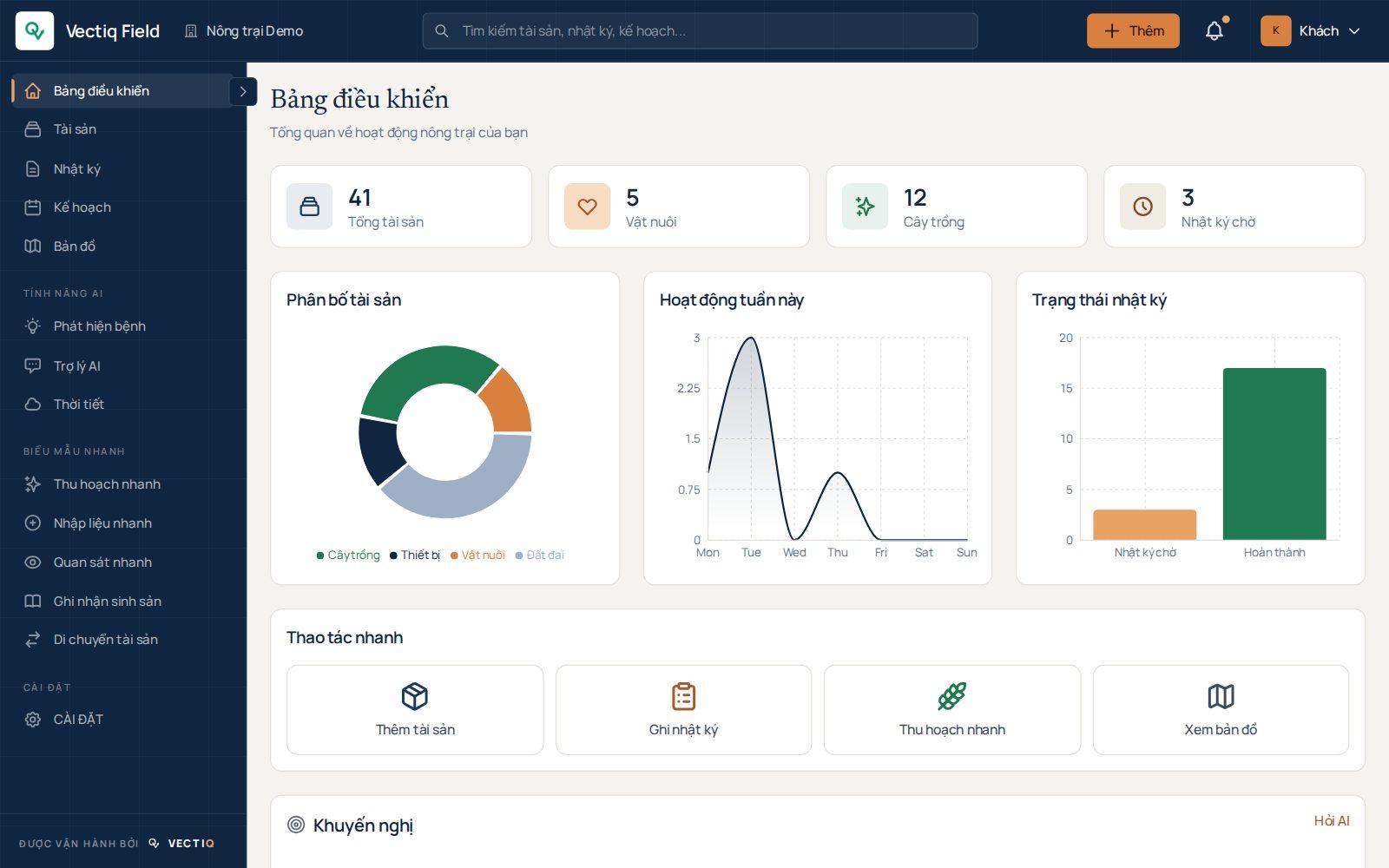
A farm that has been digitised in the usual way runs on about six systems. A sensor vendor's dashboard for soil moisture. A separate accounting package. A traceability portal the export buyer insisted on. A messaging group for the workers. A spreadsheet the owner actually trusts. And a notebook in the barn that is the only thing recording what happened this morning.
Each one is individually reasonable. Together they guarantee that no two numbers about the same farm agree, and that answering "how much did that field cost us this season" takes an afternoon of reconciliation.
Vectiq Field is built on the opposite premise: one record, and everything else reads from it.
What one record means in practice
The platform carries the farm's operational domains together rather than as integrations: assets and ID-tagged animals, crop planning and grazing blocks, activity logs and timeline, field kit for logging work outdoors, quantities and yields, accounting, invoices and treasury, data streams from IoT sensors, camera surveillance, and blockchain traceability.
That list looks like scope creep until you trace one question through it. Why did block seven yield less this season? The plan for block seven, the actual activities logged against it, the soil moisture readings over the period, the treatment records, the harvest quantity and the cost of the inputs are all rows against the same farm, joinable. In six systems that question is a project. In one it is a report.
Boundaries that match the land
Field geometry comes in as KML, so a block in the system is the actual shape of the field rather than a name in a dropdown. Plans, grazing rotations and sensor placements attach to that geometry, and PostGIS does the spatial work.
This is the unglamorous prerequisite for everything else. Without real boundaries, "yield per hectare" is an estimate the owner does not believe, and an irrigation recommendation cannot know which block it is talking about.
The AI reads the farm's own history
The AI layer is a set of specialised services behind a shared LLM gateway: retrieval, a knowledge graph, prediction, recommendation, embeddings, and vision.
The vision service is the one people ask about first: photograph a leaf, get a classification with a confidence figure. It is genuinely useful, and it is also the least interesting part, because a disease classifier is available to anyone.
What is not available to anyone is an agronomy question answered from this farm's records — what was applied to this block, when, at what rate, with what result last season. Retrieval over the farm's own history is what separates an assistant from a search engine with a friendlier tone.
Work happens in fields with no signal. The mobile field kit records locally and syncs when the connection returns; a system that requires connectivity to log a treatment will simply not be used, and the notebook in the barn wins again.
Traceability the buyer can check
Export buyers and retailers increasingly want a verifiable history of a lot, not a printed claim. Batch records are anchored on chain with smart contracts for supply agreements, and the end buyer looks the lot up by QR.
The honest framing matters here: blockchain does not make the data true. It makes it tamper-evident after the fact. The reason it is worth anything on Vectiq Field is that the batch record is assembled from the same operational log that the farm runs on day to day, rather than typed in at export time by someone reconstructing what probably happened.
Where it earns its keep
The clearest value is not any single feature. It is that the harvest figure in the accounting report is the figure that was weighed in the field, the treatment record behind the traceability claim is the one the worker logged that morning, and the AI answering a question about block seven is reading the same rows the owner would.
That is a boring outcome. It is also the one that six apps cannot produce at any price.