Vectiq MLOps - Train, Deploy, Monitor
Our MLOps platform: versioned datasets, MLflow-tracked training, a registry with quality gates, API-key endpoints with canary and shadow, drift and accuracy monitoring, and a feature store
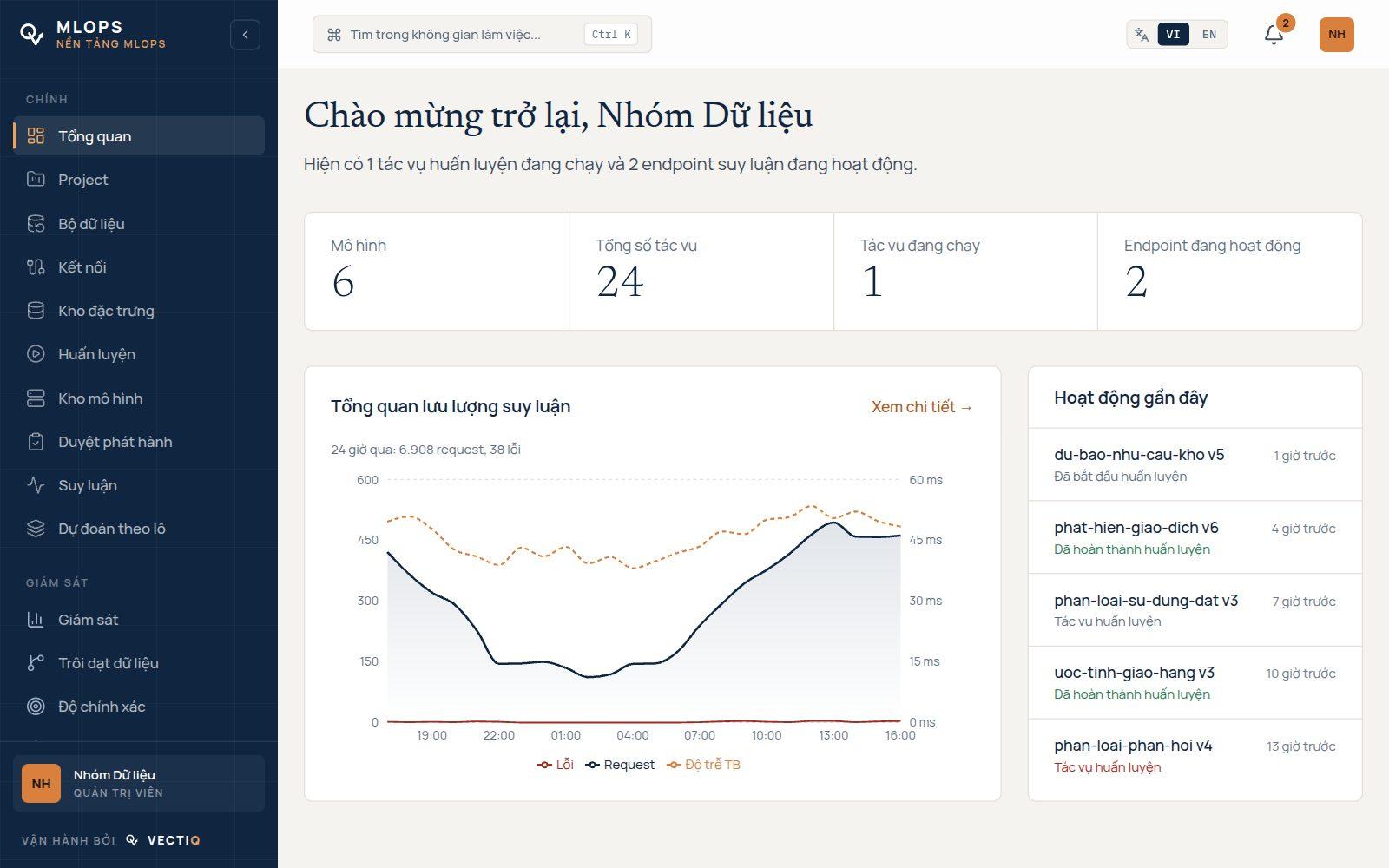
Overview
Vectiq MLOps is the platform we use to take a model from a dataset to a production endpoint and keep it honest afterwards. Six FastAPI services sit behind one gateway: collaboration (accounts, projects, audit, notifications), training, model registry, inference, monitoring and the feature store, with Celery workers for training, batch scoring and scheduled checks.
A training job saves its preprocessing and estimator as one pipeline, serialised with skops rather than pickle, so serving cannot drift from training. Promotion to production has to clear a quality gate and, if the project requires it, a second reviewer.
Endpoints authenticate by API key, split traffic for canary releases, mirror requests to shadow versions and log every call; the monitoring service compares live inputs to a baseline taken from the training data and turns ground-truth feedback into accuracy. When drift or accuracy crosses a policy, a retrain run trains a challenger and compares it with the champion on the same holdout before anything changes.
It runs on Docker Compose on a single server or on Kubernetes with one deployment per endpoint, and is covered by unit, end-to-end and Playwright tests. Our geo products build on it as their model layer.