AI Construction Progress Monitoring
Site cameras feed a pipeline that segments each image, checks safety, counts workers and turns it all into progress per phase against the plan, with timelapse and PDF reports
Overview
A timelapse camera, or any system that can call a webhook, posts each new site image to the gateway. The image is stored in object storage and two jobs go onto the queue.
The segmentation worker runs a general-purpose SegFormer model that we are adapting to construction, maps its output to the main visible site elements - earthworks, structure, facade, scaffolding, finishes - checks the image for blur, darkness and occlusion, and writes the area share of each element to TimescaleDB.
The safety worker runs a YOLOv8 model: it counts people in each image and records missing hardhats and vests, people inside danger zones defined for that camera, people close to machinery and lone workers. High and critical events are pushed to the browser over Socket.IO and, if configured, to Telegram.
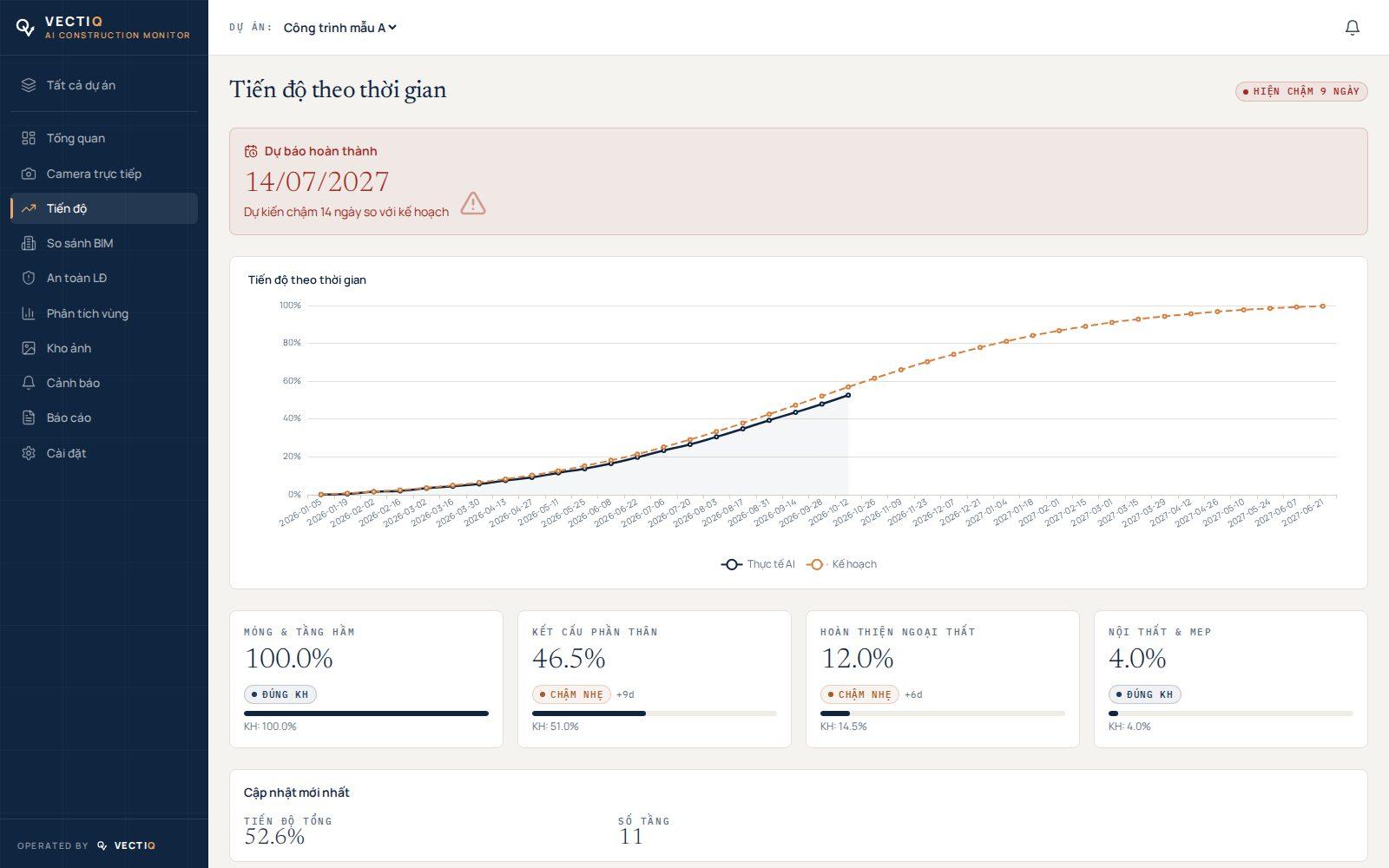
After segmentation, a progress worker takes a rolling average of the class areas, maps them to foundation, structure, facade and interior with weights calibrated per project, compares with the project schedule and writes an S-curve point, delay in days and a completion forecast; a project manager can override the estimate.
The archive can be turned into an MP4 timelapse for any camera and date range, and the report service renders a PDF with progress, safety and photos, optionally with a written summary in Vietnamese or English.
Today the system runs end to end on Docker Compose; the progress calibration still has to be tuned on real site data, and comparing the BIM model with what the camera sees is roadmap, as is an edge capture module for sites with a weak uplink.