VECTIQ
← Computer Vision & Camera AI

SmartScale - AI Anti-Fraud for Weighing Stations

A single weigh ticket can look perfectly normal: gross minus tare, signed by the operator. The fraud is in the pattern - a truck whose tare creeps up week after week, a plate that is weighed at two stations an hour apart, an operator whose night shifts keep producing odd tickets. SmartScale scores every closed ticket against the truck's, the operator's and the station's own history; an edge module with cameras at the scale, to read plates, vehicle class, axles and container numbers, is in development. Each score comes with the three reasons behind it, and alerts go out by risk level so supervisors look at the few tickets that matter instead of all of them.

Manufacturing & LogisticsEnterpriseAgriculture
SmartScale - AI Anti-Fraud for Weighing Stations

Technical capabilities

01

Camera AI at the Scale (In Development)

An edge node at the station is being designed to read the licence plate and check it against Vietnamese plate formats, classify the truck into six classes from light truck to tractor unit, count axles from a side camera and read ISO 6346 container numbers. Its vision models are not trained yet.

02

Camera Tamper Detection

A covered or sprayed lens shows up as a sudden brightness drop; a camera turned away shows up as a large difference from the learned background. Either one raises a tamper alert on its own channel.

03

Fraud Signals per Ticket

Twenty features per ticket: tare against the plate's own recent tares, net weight against declared cargo, weighing time against the station's norm for that cargo, off-hours and weekend weighing, how often the truck came today and this week, and whether the same plate was just weighed at another station.

04

Two Models, One Score

An Isolation Forest judges the ticket on its own; an LSTM autoencoder judges it as the next step in that truck's recent sequence of tickets. A weighted blend gives a 0-100 risk score, four risk levels and a recommended action for each.

05

Reasons, Not Just a Number

Every score lists the three features that pushed it up, with the value and the normal range next to it. With a trained model the ranking comes from SHAP; before that, from deviation against baseline.

06

Tiered Alerts & Reviewer Feedback

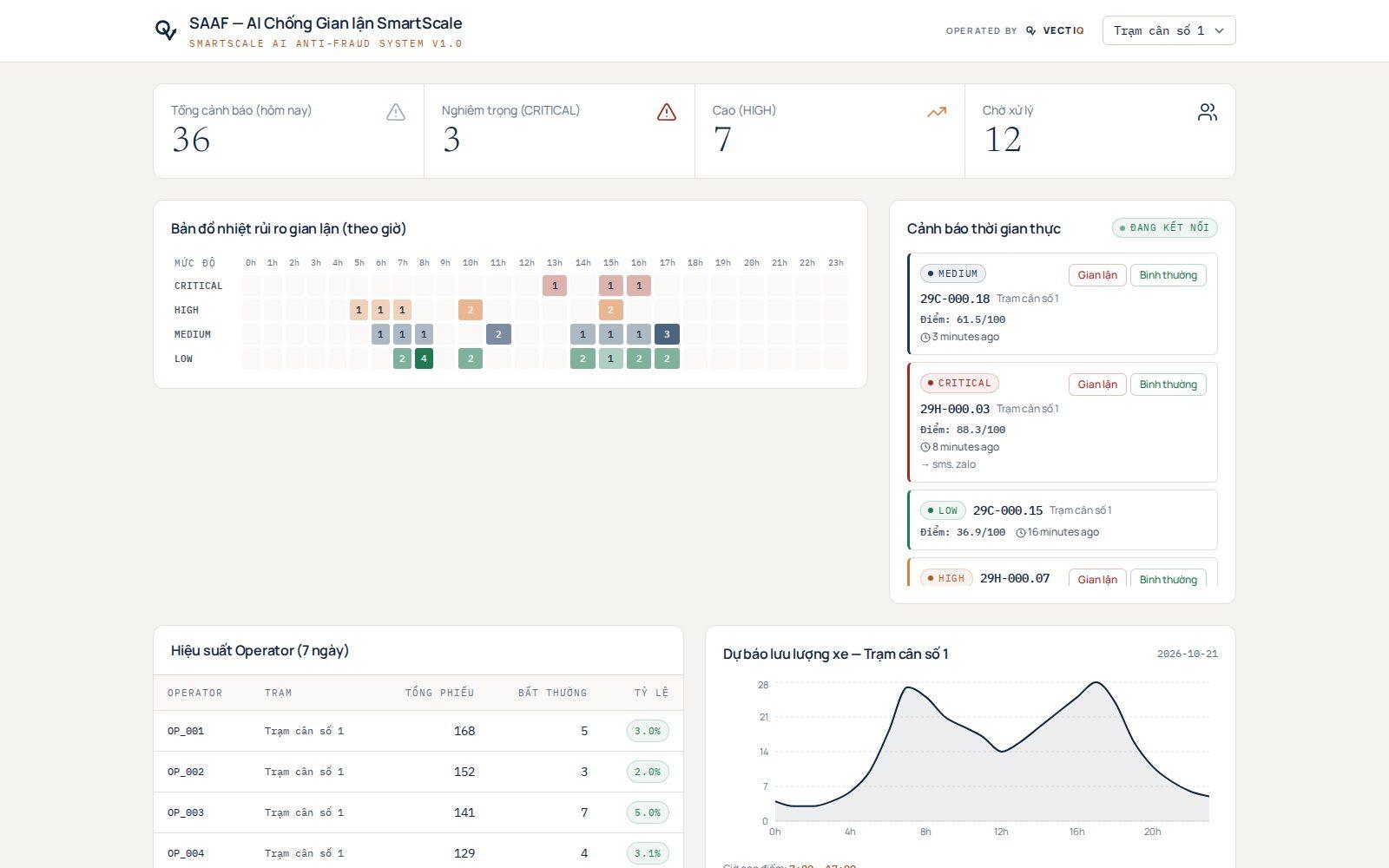
Medium risk goes to the dashboard only, high risk also to Zalo OA, critical risk also to email and SMS. Reviewers acknowledge alerts and mark each one as true fraud or false positive, and those labels are what the next model is evaluated against.

07

Operator & Station Analytics

Anomaly rate per operator over the last seven days, a heatmap of alerts by hour of day and risk level, and a 24-hour traffic forecast per station with peak hours and a suggested number of operators per shift block.

08

Predictive Scale Maintenance

Loadcell telemetry - zero-tracking drift, calibration age, overload events - is trended per loadcell to project the day it will drift out of tolerance, with a warning well before that day. A drifting scale shortchanges one side of every deal without anyone meaning to.
Processing pipeline

01

Cameras & Scale

RTSP / Loadcell

02

Edge Node

YOLOv8 / PaddleOCR

03

Ingest

MQTT / RabbitMQ

04

Features & Scoring

Redis / IF + LSTM

05

Store & Explain

ClickHouse / SHAP

06

Alerts & Dashboard

Zalo / SSE / React

Deployment scenarios

Quarries & Construction Materials

Sand, Gravel and Coal Sold by the Tonne

When the product is sold by weight, every kilogram on the tare side is money. SmartScale compares each tare with the same truck's previous tares and the net weight with what was declared, and weighs in the cargo types that carry more risk.

  • Tare compared with the plate's own recent tares
  • Net weight compared with declared cargo
  • Higher-risk cargo types (sand, gravel, coal, scrap) weighted in the score
  • Off-hours and weekend weighing flagged
  • Camera plate reading at the scale, in development
Tare CheckIsolation ForestANPRBulk Materials
Factories & Scrap Purchasing

When the Problem Is at the Desk

Some fraud needs the operator's help: a truck weighed twice, a ticket closed too fast to be real, a night shift that keeps producing odd tickets. SmartScale tracks each operator's anomaly rate and puts suspicious tickets on hold for review before they reach payment.

  • Anomaly rate per operator over the last seven days
  • Weighing time scored against the station's norm per cargo type
  • Repeat weighing of the same truck within a day or a week
  • Recommended action per risk level, up to holding the ticket
  • True fraud / false positive labels from reviewers
Operator AnalyticsHuman-in-the-loopExplainabilityZalo OA
Station Networks & Container Logistics

One Plate, Two Stations, One Hour

With several stations reporting to one system, a plate seen at two of them within two hours is either a cloned plate or a ticket that should not exist. Supervisors see every station from one dashboard; reading container numbers at the scale is part of the edge module in development.

  • Cross-station check on the same plate
  • ISO 6346 container number reading at the scale, in development
  • Alert heatmap by hour of day and risk level
  • Live alert feed per station over server-sent events
  • Edge-to-cloud link over MQTT with TLS client certificates, in development
Multi-stationContainer OCRMQTTHeatmap
Agricultural Purchasing Points

A Fair Scale in the Harvest Rush

At a purchasing point the queue builds up in the harvest season and the scale works without pause. SmartScale forecasts the hourly load to plan operators, warns before a loadcell drifts out of tolerance, and keeps scoring tickets when everyone is too busy to check them by hand.

  • 24-hour traffic forecast with peak hours per station
  • Suggested operator count per shift block
  • Loadcell drift trend and calibration warnings
  • Every ticket scored, not a random sample
ForecastingPredictive MaintenanceLoadcellProphet

Tech stack

FastAPIscikit-learnPyTorchONNX RuntimeYOLOv8PaddleOCRNVIDIA JetsonMQTTRabbitMQRedisClickHouseReact

Related projects